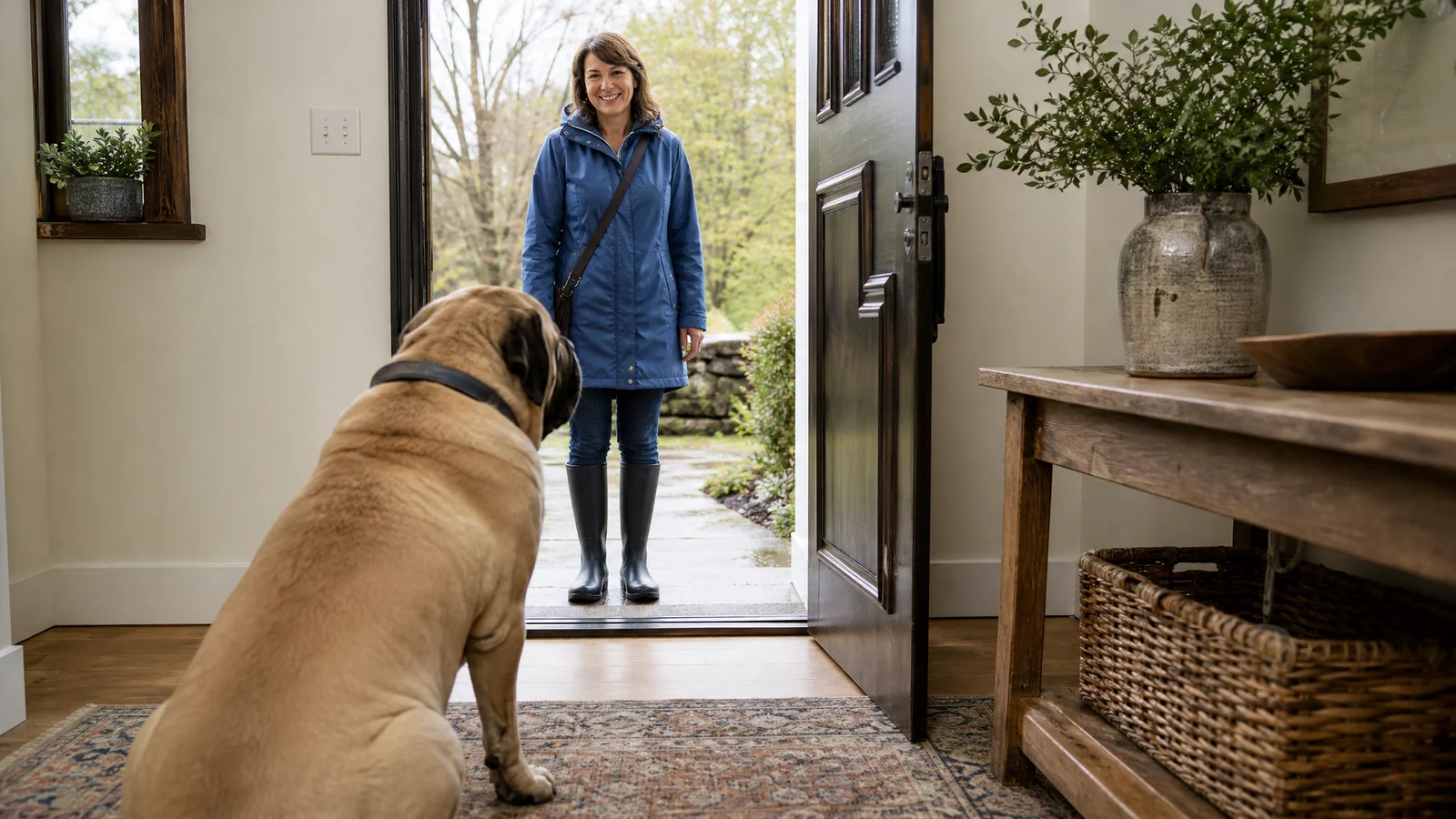
Can a friendly English Mastiff greet visitors at the front door? Yes, but the answer depends less on a perfect sit than on what the room allows everyone to do. A huge dog, an opening door, bags and a person stepping inward can create unsafe traffic before the dog has made any clear choice.
In this guide, we will map that traffic, separate an arrival into three scenes, compare leaning with jumping and adapt the arrangement for different visitors. The household will finish with a weekly review that changes one condition at a time. The goal is a greeting that remains optional for the guest and the Mastiff.
This is not a test of whether the dog is friendly. It is a plan for where bodies move, when social contact begins and how it ends before excitement or discomfort turns a greeting into a physical problem.
Why Doorway Behavior Problems Start Before the Bell
The official Mastiff standard describes a massive, dignified dog. That size makes a rushed greeting consequential even when the dog is seeking affection. A visitor should not discover the household rule while trying to keep balance beside an open door.
\nThe site's Mastiff temperament guide adds context for sensitive, readable training. Breed traits can shape management, but they do not predict what one dog will feel about a visitor.
Look at the ten seconds before contact. The dog may hear the bell, watch a person hurry to the entry and see a stranger bend through the doorway. If the leash appears only after arousal rises, the household is asking equipment to organize a scene that people left unplanned.
Move the Mastiff to a familiar resting area before receiving a real visitor. The host can open the door, bring the person inside and put belongings down without the dog threading through the traffic. This is ordinary management, not a consequence for excitement.
Keep greetings optional. A dog who hangs back, stiffens or turns away should gain space rather than encouragement to approach. A visitor who does not want contact should be able to enter and sit without becoming a helper.
Regular veterinary care belongs in the larger behavior plan. Sudden touch sensitivity, reluctance to rise or an abrupt change in social behavior can accompany discomfort. Those changes need veterinary attention instead of a more demanding greeting rehearsal.
A Room Map Prevents English Mastiff Behavior Problems
Sketch the entry and adjacent room before choosing a cue. Mark the door swing, narrow passages, furniture edges and the route to the dog's resting area. The best training position is one where the handler can guide a broad turn without blocking the visitor's exit.
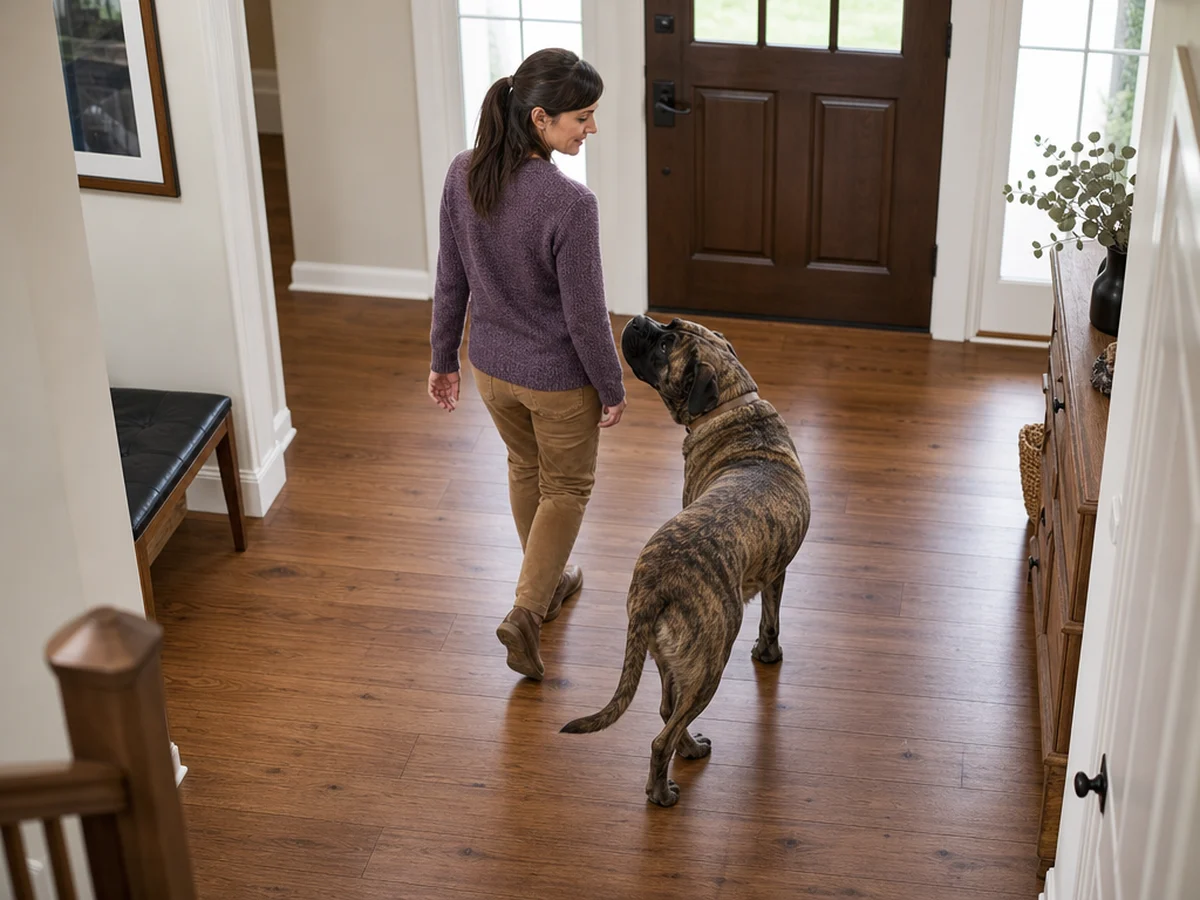
Divide the room into functions. The arrival lane belongs to the host and guest. The observation zone gives the Mastiff space to look and disengage. The contact spot has enough open floor for the dog to stand without pinning anyone against a wall.
| Room Zone | Person Using It | What the Dog Learns There |
|---|---|---|
| Arrival lane | Host and visitor | People can enter without direct access |
| Observation zone | Handler and Mastiff | Looking and turning away both earn support |
| Contact spot | Willing helper | Grounded, loose approach opens brief contact |
| Resting area | Mastiff alone or with handler | A greeting can end without conflict |
Practice movement between the observation zone and resting area when nobody is visiting. Reward the dog for following the handler through a wide curve, settling briefly and returning on a release. The path should already feel familiar before the doorway adds noise.
Place rewards with the handler, away from the visitor's hands. Food held over a large head can invite upward movement, while food delivered low after a marker supports grounded posture. The marker training guide explains how a marker identifies the successful instant before the reward arrives.
Do a human-only rehearsal next. The helper enters, pauses and walks to the contact spot while the host watches for bottlenecks. If people cross paths or the helper becomes trapped beside furniture, change the map before adding the dog.
The Three-Scene English Mastiff Greeting
A complete greeting is easier to understand when it is divided into arrival, observation and contact. Each scene has its own ending. The Mastiff does not flow automatically from hearing the door to touching the visitor.
\nArrival, Observation and Contact
Scene one, arrival. The dog remains in the resting area while the host receives the person. The visitor puts down bags, hears the short script and reaches the planned location. If the entry stays busy, the dog can remain out of the scene for the entire visit.
Scene two, observation. The handler brings the Mastiff to the observation zone on a soft leash. Reward a grounded look, a head turn or a choice to stay beside the handler. Do not ask for contact while the dog is pulling forward, retreating or unable to take food.
Scene three, contact. The helper stands sideways and keeps hands low. The dog may approach, sniff and leave. If the body remains loose and the paws stay grounded, the helper offers a short touch to the shoulder or chest, then removes the hand before another decision.
Close the scene with a release away from the visitor. The handler moves back to the resting area or another quiet activity and rewards the transition. A clear ending prevents prolonged petting from turning into leaning, pawing or a second, faster greeting.
The humane training statement recommends rewards alongside thoughtful environmental management. Here, management keeps the entry safe, while access to observation and brief contact reinforces the choices the household wants repeated.
Limit early practice to one clean sequence. Repeating until the dog is tired makes the later scenes look different from the first and can teach anticipation. Another quiet visit can supply the next repetition.
Leaning and Jumping Are Different Behavior Problems
Leaning develops as the Mastiff shifts weight into a person during contact. Jumping is an upward movement that may begin before contact or erupt when attention increases. Both can unbalance a guest, but reviewing the wrong moment leads to the wrong change.
| Pattern | First Useful Moment | Change for the Next Greeting |
|---|---|---|
| Weight gradually presses into the helper | Shoulder begins to drift during petting | Shorten contact and reward balanced standing |
| Front paws lift on approach | Speed rises before reaching the person | Increase approach distance and end sooner |
| Dog bounces after food | Reward hand moves upward or forward | Deliver low beside the handler |
| Dog retreats after touch | Head turns or weight shifts away | Remove contact and allow departure |
For leaning, the helper removes hands before carrying the dog's weight. The handler marks the step back into balance and rewards low. The next contact is shorter, so the Mastiff can succeed without using a person as support.
For jumping, the helper steps away and the handler makes room for the dog to return to the floor. Reward grounded recovery, then decide whether a calmer observation scene is available. There is no obligation to reopen contact during the same visit.
Best Friends recommends frequent rewards for polite greetings while learning. Its greeting guidance makes human attention part of the consequence. In this room plan, contact pauses when paws lift and resumes only after a new, easier setup.
Do not push the dog down or brace against a lean. Those responses add physical interaction at the moment contact should become quiet. The visitor simply leaves the contact role while the handler supports the next grounded choice.
The linked welfare research reported more stress-related behavior in dogs trained at schools that relied more heavily on aversive methods. Our plan instead uses distance, clear access and reinforcement to keep a social doorway understandable.
Visitor Scenarios Change the Behavior Plan
One greeting format does not fit every visitor. Keep the room zones stable, then decide whether contact belongs in the visit at all. The person's movement, balance and willingness matter as much as the dog's current skill.
A Familiar Adult Who Wants to Help
Use this person for early rehearsals because their movement can remain predictable. They can enter without calling the dog, wait in the contact spot and follow the three-scene sequence. Ask for one brief contact rather than a long reunion.
Familiarity may increase excitement, so do not assume the easiest person produces the easiest dog. If speed rises, begin at the observation zone and release away after a grounded look. The helper's affection remains available on a later repetition.
An Unfamiliar Visitor or Service Person
Skip contact and use full separation when someone is working, carrying equipment or moving repeatedly through the home. The person's job is not to train the Mastiff. A closed barrier and comfortable resting area protect both parties while the household manages access.
If a visitor will stay and the dog can observe comfortably, the Mastiff may watch from the observation zone without approaching. Reward disengagement and return to rest. Neutral coexistence is a complete success.
Children and People With Limited Balance
These visitors remain outside the training area. Adults operate barriers, handle the leash and decide whether the dog is present. A calm dog can still change direction or lean unexpectedly, so previous success with a steady adult does not remove the management need.
Use the site's Mastiff training guide to keep marker and release words consistent. The safest household rule applies even when one confident guest says they do not mind jumping.
Notice whether the dog chooses rest after the greeting. Easy recovery is part of the result. Continued pacing, scanning or repeated attempts to return to the visitor show that the sequence asked for more regulation than the dog currently has.
A Weekly Review of English Mastiff Behavior Problems
Review several arrivals rather than judging one dramatic event. Record the visitor type, room arrangement, first change in the dog's body, whether contact occurred and how easily the Mastiff returned to rest. Facts about the sequence are more useful than labels such as pushy or stubborn.
- Keep the room map if people moved without crossing or blocking one another.
- Keep the observation distance if the dog could look, turn and take food.
- Shorten contact if leaning grew before the helper removed hands.
- Increase distance if jumping began during the approach.
- Use full separation when recovery stayed difficult after the scene ended.
Change one condition during the next planned practice. Moving the contact spot while also adding a new visitor and a longer greeting makes the outcome hard to interpret. A single adjustment shows whether the room, timing or contact length was carrying the problem.
Consult a credentialed trainer whose plan centers rewards when the household cannot arrange a safe rehearsal, jumping is escalating or the dog shows fear around visitors. Provide the room sketch and sequence notes so the professional can see what happens before contact, not only the final movement.
Long-term manners do not mean the front door runs without people. The household will still prepare the room and decide whether a greeting is appropriate. What improves is the sequence: the English Mastiff can observe without rushing, accept a brief voluntary hello and leave the scene before leaning or jumping takes over.
 Exercise and jobsSafe Play and Short Walks for a Growing English Mastiff Puppy
 BehaviorWiping Faces and Wrinkles: Handling an English Mastiff Who Drools
 BehaviorLeaving Your English Mastiff Home Alone Without the Drama