
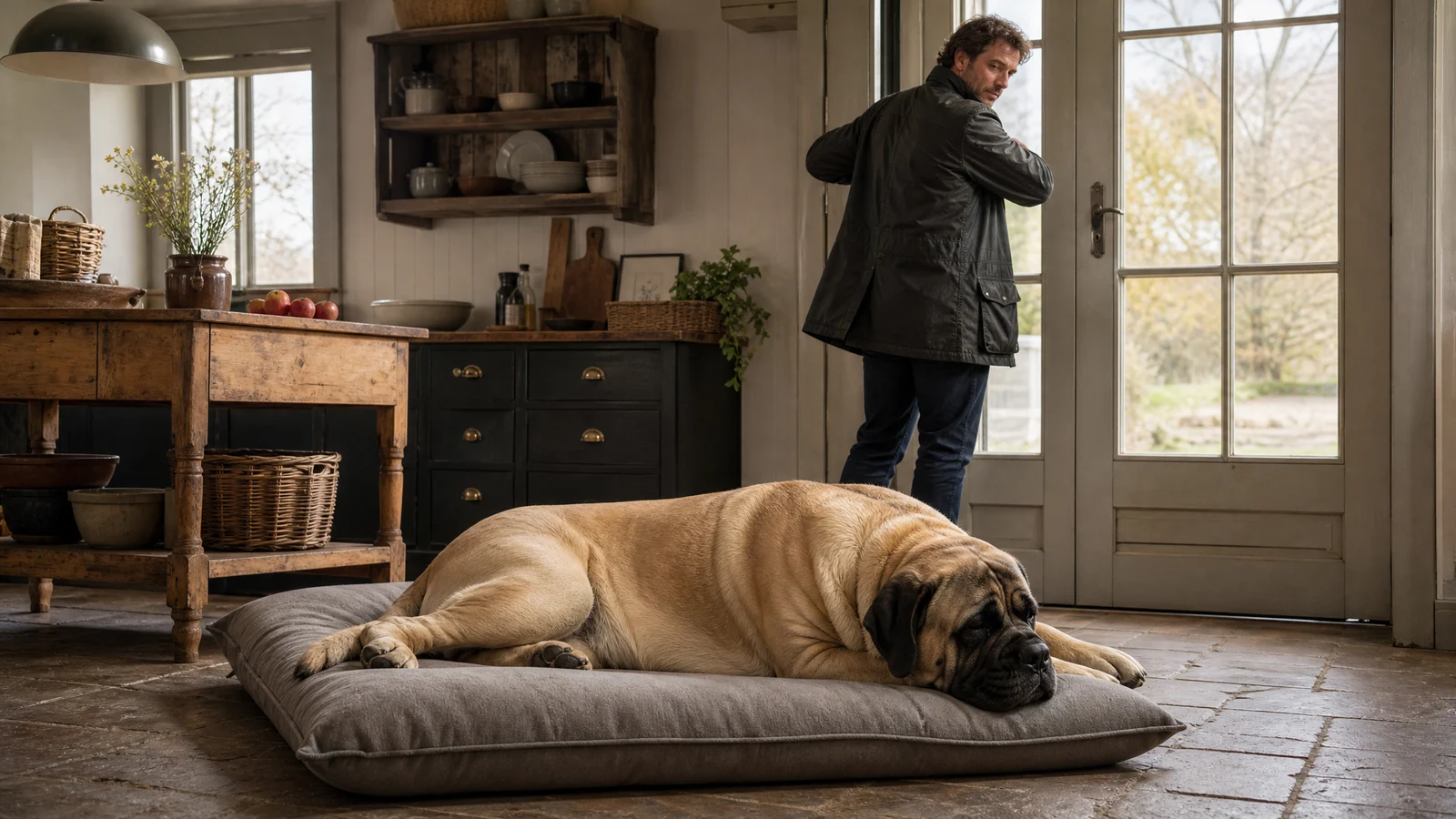
An English Mastiff may spend much of the day resting near the family and still struggle when every person leaves. A quiet return home does not prove the absence felt easy. Some dogs pace, watch the exit or stop using familiar activities without leaving obvious damage.
In this guide, we will build time alone around a two-week household calendar. You will identify the dog's ordinary rest base, arrange care beyond the practiced level, rehearse small separations and review video before changing the plan. The calendar organizes evidence rather than promising a number of minutes.
The first job is not to make departure longer. It is to keep real life from outrunning the lesson while the Mastiff learns that ordinary separation can end calmly.
Read the English Mastiff Time Alone Baseline
Observe the dog while someone is still home. Note where the Mastiff chooses to rest, how they respond when a person crosses a doorway and how easily they settle after ordinary household movement. This is the baseline the absence plan should preserve.
Use a camera to view the rest area and main exit during a normal household separation. Start recording before keys, shoes or bags move. The sequence before the door closes may contain the earliest useful change.
The ASPCA separation overview distinguishes absence-linked distress from ordinary house-training or behavior problems by looking at clusters and timing. One chewed object or one bark cannot establish the cause.
Sort the observation into practical signals. Do not assign a condition from the list. Use it to decide whether another easy practice is appropriate or whether the case should move to professional help.
- Green: ordinary posture, use of the usual rest place and easy recovery after the person returns.
- Yellow: repeated exit watching, abandoned food, unsettled movement or slower recovery.
- Red: escalating vocalizing, attempts to force an exit, inability to settle or other persistent distress.
Do not react to the recording as a moral report. Clean up calmly if needed, save the sequence and change the next setup. Punishment after a return cannot show the dog which behavior would have made the absence easier.
Raise sudden behavior changes during regular veterinary care. Pain, changing senses or another health concern can alter rest and tolerance. The video gives the veterinarian a clearer description of when the change appears.
An English Mastiff Rest Base Before Time Alone
Choose the place where the dog already rests comfortably, not the room that is easiest to clean. Provide water, secure footing and enough space for the Mastiff to turn and lie naturally. Clear loose items, dangling objects and anything the dog might ingest or pull toward the doorway.

Spend ordinary time in the area without leaving. Read, work or move around while the dog chooses rest. The base should predict normal life before it becomes part of a separation rehearsal.
Try each food activity or supervised chew with company first. Confirm that the Mastiff engages comfortably and handles the item appropriately. Refusal during a later separation becomes evidence about comfort, not a reason to keep increasing food value while the absence continues.
A crate is not automatically the right rest base. Crate comfort must be taught as a separate skill. A Mastiff who becomes distressed in confinement needs a different assessment rather than a closed crate used as an automatic answer.
Add a clear household signal that the base is available, then release the dog freely during ordinary practice. The dog should be able to leave while a person is home. Voluntary use gives you a better baseline than repeatedly directing the Mastiff back to a bed. If the dog monitors doors or outside movement from that spot, use the Mastiff guarding guide to choose a quieter setup without confusing watchfulness with absence distress.
Coverage Protects Time Alone Training
List the absences the household cannot avoid during the next two weeks. Training trials should remain below the dog's observed limit, while family, friends or suitable professional care cover anything longer. This prevents the calendar from becoming a series of emergencies.
Use the matrix to make responsibility visible. A vague promise that someone will check on the dog can fail at the exact moment the plan needs protection.
| Calendar Event | Training Choice | Coverage Choice |
|---|---|---|
| Planned easy rehearsal | Record the full sequence | No extra care needed |
| Work or appointment beyond practice | Do not count it as training | Arrange a known caregiver |
| Delivery or noisy home event | Lower the challenge | Keep a person with the dog |
| Unexpected schedule change | Cancel the trial | Use the backup contact |
Tell every caregiver which area, routine and activities the dog already knows. A coverage visit is not the moment to introduce a new confinement plan. Keep handoffs quiet and record any change in behavior.
The calendar should include recovery days with no planned departure trial. Ordinary calm keeps the dog from learning that every use of the rest base predicts a harder absence.
\nWrite the primary caregiver and backup beside every real-world event. Include travel time and possible delays, not only the appointment itself. If the coverage window cannot protect the dog's current level, change the human schedule or care arrangement rather than turning that absence into an uncontrolled endurance test. Write the confirmed plan where every caregiver can see it before leaving day arrives.
Protect the plan even after a few good recordings. A single comfortable trial does not establish readiness for the household's full schedule. Coverage gives learning time to become reliable.
Household Separations Before Time Alone
Practice the smallest version inside the home. One person crosses a familiar barrier while the Mastiff remains at the rest base. Return before the video or direct observation shows a meaningful change from baseline.
Keys, shoes and a coat can become separate lessons if they trigger concern. Pick up one item, set it down and continue an ordinary activity. Use only a few neutral repetitions, then return the item to ordinary household life before the dog becomes watchful.
PDSA's communication guide explains that early discomfort may appear as a yawn or a head turn before behavior escalates. Read those signals as a reason to reduce the step, not as disobedience.
Keep returns low-key and readable. Come back, pause and resume ordinary household life. The dog should not need to choose between an emotional reunion and another immediate departure.
Vary easy repetitions instead of making every separation longer. Cross the doorway and return, then later touch the door and remain inside. The Mastiff learns flexibility without a staircase in which the next event is always harder.
Coordinate with the site's Mastiff grooming routine so departure practice does not collide with face care, visitors or another demanding event. One main learning task per period makes the recording easier to interpret.
The Two-Week English Mastiff Time Alone Calendar
The calendar has phases, not promised durations. Advance when video remains close to baseline and recovery stays easy. Return to the previous phase when yellow signals appear, and stop planned absences when red signals appear.
Phase One Uses Ordinary Rest and Interior Movement
Record several normal rest periods while people move within the home. Practice crossing an interior doorway and returning while the dog remains comfortable. Include days with no formal repetition.
Review the complete recording, including the moments after return. A dog who remains rigid until the person sits down has not shown the same recovery as a dog who simply continues resting.
Phase Two Separates Cues From Departure
Introduce one real cue at a time, such as shoes or keys, and then continue an ordinary activity. Mix the cue into the day so it no longer guarantees a separation. Stop if the Mastiff begins following, scanning or abandoning rest.
Keep the rest base available during cues but do not repeatedly send the dog there. The useful evidence is whether the Mastiff can choose ordinary behavior while the cue occurs.
Phase Three Adds Recorded Exterior-Door Trials
Run an exterior-door trial only after the easier phases remain green. Start the camera before the cue sequence, complete one familiar departure and return while the dog is still comfortable. End the session after reviewing the recording.
Do not run several exits close together to collect data. Repeated departures can make the door sequence more important and change the very baseline you are trying to protect.
At the end of two weeks, review the pattern rather than announcing a final duration. The calendar may show steady green trials, a cue that consistently creates yellow signals or evidence that professional help should replace further testing.
English Mastiff Video and Recovery Decisions
Review posture, location, use of activities and movement toward the exit. Silence alone is not a pass. A dog can remain quiet while standing rigidly or watching the door for the entire separation.
The RSPCA's separation guidance notes that relevant behavior can begin before or soon after the person leaves. Keep that early part of every recording instead of trimming to the longest quiet section.
Write the first change, not only the worst one. If the Mastiff stops eating when keys move, that moment is more useful for the next setup than the later pacing. Practice can return to the cue before another door trial.
Recovery after return is another decision point. Watch whether the dog resumes the normal rest position, drinks, explores or remains focused on the person. A slow return to baseline calls for an easier next event.
Review the calendar once a week. Daily judgment can tempt the household to chase a better result immediately after a difficult trial. A weekly view makes repeated signals and coverage failures easier to see.
When English Mastiff Time Alone Needs Help
Stop departure trials when a very small separation already disrupts comfort, the dog works urgently at an exit, familiar activities lose all value or concern rises during the preparation sequence. Protect the Mastiff from unavoidable absences beyond the practiced level while help is arranged.
Share the videos, calendar and preparation sequence with the veterinarian and an appropriately qualified behavior specialist. The American College of Veterinary Behaviorists explains on its owner resource that board-certified veterinary behaviorists have specific veterinary behavior training. The record helps any professional see the sequence rather than rely on a label.
When choosing a trainer, ask exactly which methods will be used. Best Friends' trainer questions recommends asking about techniques and moving on when the answer is unclear. The plan should center rewards, careful setup and the dog's observed threshold.
The next two weeks have two priorities. Keep real absences within the coverage plan, and schedule only practices the previous recording supports. Calm time alone grows from protected, reviewable experiences, not from testing how long an English Mastiff can endure the closed door.
 Training basicsAre English Mastiffs Easy to Train? Temperament Explained
 Training basicsEnglish Mastiff Crate Training Without Separation Distress
 BehaviorIs an English Mastiff a Good Guard Dog? Guarding Explained